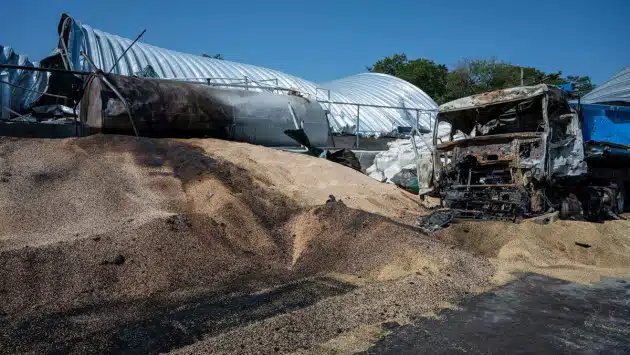
Russia continues to attack ports and ships in Ukrainian waters. However, the consequences of this campaign are felt most strongly on land. Ukraine is facing an economic crisis if the Ukrainian authorities do not find a solution soon, writes The Kyiv Independent.
This primarily concerns Ukrainian agricultural and metallurgical companies, which are key drivers of the country’s economy. They are effectively cut off from the main trade routes through the Black Sea. According to Olena Bilan, chief economist at investment company Dragon Capital, Ukraine could lose 1–1.5% of GDP by the end of the year.
There is no clear solution to the crisis yet. Land routes are unable to transport the same volumes as the Black Sea and are much more expensive. Ports on the Danube are also under Russian attack and suffer from record low water levels.
It seems that land border crossings will remain the only option. At best, they will be able to provide 1.5 million tons of cargo (agricultural products). And we need about 5 million tons per month,” said Bohdan Kostetsky, an operating partner at consulting firm Barva Invest.
The consequences are already serious. Logistics costs for grain have increased by $50 per ton. Domestic grain prices have fallen sharply. Agricultural exports last month fell by 23% compared to June. Metallurgical giants Ferrexpo and Metinvest have halted production at several facilities because they can neither import nor export products.
In the long term, farmers who are short of working capital may reduce their acreage. Metallurgical companies may cut staff. Prices for consumers may rise along with the increase in railway tariffs. They have already risen by 30% this month due to attacks on ports.
For now, Ukrainian farmers are choosing to store grain rather than pay sky-high prices for exports. The authorities are looking for a solution. But the critical moment will come in mid-September, when the corn harvest begins. Ukraine expects a high harvest, and warehouse space is running out. In addition, corn is one of the key grain commodities. It is focused on the Chinese market. But its export requires deep-sea ports and large vessels.
Ukraine is looking for support from partners. One option is to export through four Polish ports despite Warsaw’s current ban on Ukrainian grain imports.
Currently, Ukrzaliznytsia is negotiating with Moldovan railways for a 50% discount on the transit tariff. The goal is to reduce the cost of transporting goods to the Romanian port of Constanta.
Kyiv has also asked the EU for a grant of 220 million euros (about $254 million). The funds are to support small and medium-sized farmers — to help them pay interest on bank loans under the state program “5-7-9%”
At the same time, Turkey, which is acting as a mediator in the negotiations between Russia and Ukraine, has called for a moratorium on strikes in the Black Sea. The first results of negotiations on the resumption of sea transportation may appear on August 20, Valeriy Tkachev, deputy director of the commercial department of Ukrzaliznytsia, told ASAP Agri. He later confirmed this to the Kyiv Independent.
Separately, the Ukrainian military is also working on physically unblocking the ports, he added.