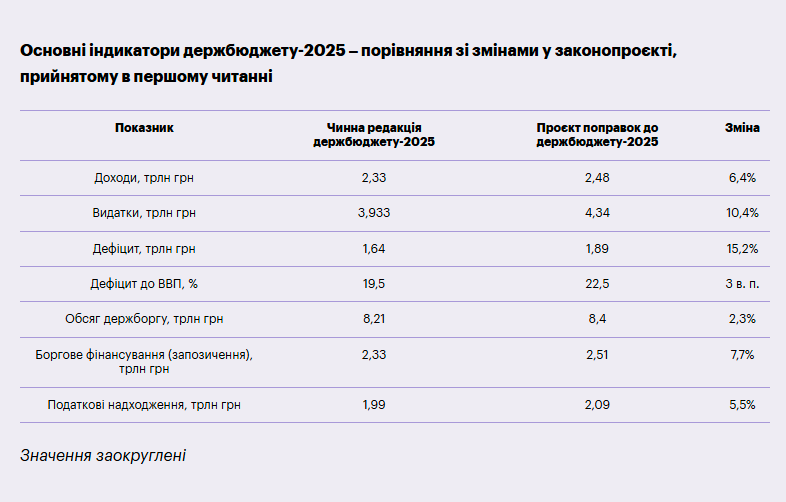
The Verkhovna Rada approved amendments to the law on the state budget for 2025 in the first reading. This is bill No. 13439-3, which provides for an increase in the expenditure part of the state budget by UAH 409 billion, to UAH 4.34 trillion.
These funds will be directed to the security and defense sector. And in order to cover the costs, the deputies propose to increase the revenue part of the state budget (mainly at the expense of tax revenues), as well as to expand debt financing of the state treasury.
As a result, the limit of the state budget deficit in 2025 will increase by 3 percentage points – to 22.5% of GDP, and the state debt – by 2.3%.
What is important: it is proposed to remove restrictions on exceeding the limit level of state debt by the amount of loans from the European Union, other states and foreign financial institutions, if the repayment of such loans is not carried out from the state budget. For example, at the expense of income received from frozen Russian assets, which should allow Ukraine to increase external loans, but at the same time avoid an increase in the amount of public debt.
Mind figured out how the budget will be balanced in connection with growing expenses.
What will the updated state budget be
If compared with the current version of the state budget-2025 (law No. 4059-IX), the expenditure part of the budget will increase from UAH 3.93 trillion to UAH 4.34 trillion, the revenue part will increase from UAH 2.33 trillion to UAH 2.48 trillion.
The state budget deficit in 2025 will reach UAH 1.9 trillion, which is 22.5% of GDP. The maximum size of the state debt in 2025 will increase from UAH 8.21 trillion to UAH 8.4 trillion, or to 99.4% of GDP.
However, one should not forget about the norm that will allow borrowing money from external donors above this limit. Formally (on paper), this should not lead to an increase in the threshold amount of state debt, but in fact the total state debt will still grow and will exceed 100% of GDP by the end of 2025.
The text of the bill contains a clarification that the Cabinet of Ministers reserves the right to make a decision on a temporary suspension of payments on state obligations until October 1, 2025, until new conditions are agreed with creditors.
If you read between the lines, this means that the government intends to foresee in advance the possibility of restructuring debts that Ukraine cannot repay on time.
Who the deputies can add funding to
The main recipients of additional funds from the budget in 2025 will be:
Ministry of Defense: + UAH 321 billion (an increase to UAH 1.89 trillion). Almost UAH 194 billion will be spent on the purchase, modernization and repair of weapons and military equipment. UAH 115 billion is provided for additional support for the Armed Forces, in particular for personnel training and medical care for servicemen.
Ministry of Internal Affairs: + UAH 84 billion (up to UAH 522.5 billion). Funding for the National Guard will increase by UAH 24.6 billion (up to UAH 186.7 billion), for the National Police – by UAH 13.7 billion (up to UAH 118.4 billion).
Main Intelligence Directorate: + UAH 4.6 billion (up to UAH 29.7 billion).
Security Service: + UAH 1.6 billion (up to UAH 43.3 billion).
Ministry of Veterans Affairs: + UAH 2 billion (up to UAH 5.37 billion).
Ministry of Health: + UAH 2.8 billion (up to UAH 219.5 billion).
Ministry of Strategic Industries (to be merged with the Ministry of Defense): +4.5 billion UAH (up to 59.8 billion UAH).
Ministry of Digital Transformation: +6.4 billion UAH (up to 10.6 billion UAH).
The deputies also propose to distribute the revenues of the special fund of the state budget (204 billion UAH) in 2025 as follows (from August 31 to December 31):
15% – to the Ministry of Defense for the purchase of special equipment and equipment;
45% – to the Ministry of Strategic Industry for programs for the reform and development of the defense-industrial complex, for the development and production of defense products;
30% – to the State Service for Special Communications and Information Protection for the purchase of equipment and equipment;
10% – to military units of the Armed Forces of Ukraine and other military formations for logistical support.
Where will the money for defense come from?
According to the draft, tax revenues in 2025 will amount to almost UAH 2.1 trillion, which is UAH 97 billion more than planned in the current version of the law on the state budget (for more details, see “Main sources of additional revenues…”).
Financing from debt operations for 2025 has been increased from UAH 2.33 trillion to UAH 2.51 trillion. Additional borrowings, which will lead to an increase in state debt, are planned only on the domestic market at the expense of government bonds – the total volume of their placement will increase from UAH 579 billion (in the current version of the state budget) to UAH 764 billion, i.e. by UAH 185 billion.
At the same time, in the first half of the year, the Ministry of Finance raised UAH 240 billion through government bonds, which is slightly more than 30% of the adjusted amount to which debt financing will increase in 2025. And net financing at the expense of government bonds (raising minus repayment) for the entire year 2025 will amount to slightly more than UAH 137 billion.
How the revision of the 2025 state budget will affect 2026
In fact, the Cabinet of Ministers and the Verkhovna Rada still have room for maneuver – the expected volume of external financing in 2025 is $54 billion, or about UAH 2.2–2.3 trillion.
In the event of an increase in the expenditure part of the state budgetete by $9.6 billion (this is approximately 409 billion UAH), the deficit in 2025 will reach $45–45.5 billion. Accordingly, even if the fiscal gap is covered exclusively by external financing, these funds will be enough with a margin.