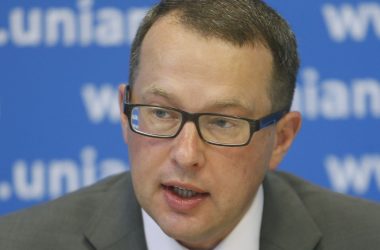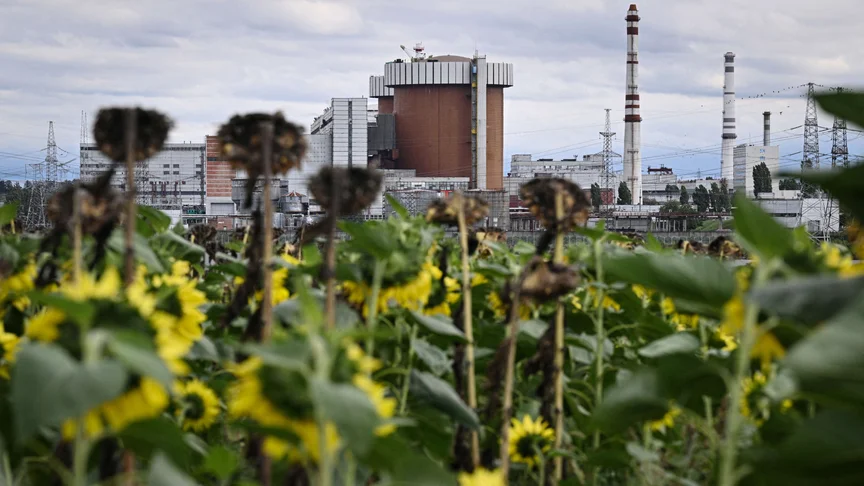
“Honestly, I don’t know when Energoatom had a crystal-clear reputation. Will the energy sector ever recover after all this? It’s not just Energoatom,” Oleksiy Orzhel, head of the Energy Community office in Ukraine and former Minister of Energy, shares his thoughts.
The NABU investigation and, as a result, the corruption scandal that has arisen around the state-owned energy company, which generates over 50% of the country’s electricity, raise many questions. They are especially acute now, as millions of Ukrainians sit without electricity for hours.
Is everything really that bad at Energoatom, a company that has 25,000 employees and operates the Yuzhnoukrainska, Rivne, and Khmelnytskyi nuclear power plants with a total capacity of 7.9 GW (out of 14 GW of capacity currently available in the entire Ukrainian system) on the territory controlled by Ukraine?
How the corruption scandal affected the work of Energoatom
According to NABU, at least $100 million passed through the shadow accounting system, which a group of businessmen, probably led by Timur Mindich, organized on the basis of Energoatom’s cash flows. Converted into hryvnias, this is 4.2 billion hryvnias.
According to NABU investigators, the businessmen demanded “kickbacks” of 10-15% of the value of the contracts, and later withdrew part of these funds in cash.
From the beginning of the Great War to November 2025, according to the Prozorro public procurement system, Energoatom made purchases worth 37.4 billion hryvnias. If the “kickbacks” at a rate of 10-15% alone amounted to a total of 4.2 billion, then the businessmen could probably earn on the entire volume of purchases, and not just on the construction of protective structures.
If we count the purchases of Energoatom and its branches and subsidiaries for the period from February 2022 to November 2025, this volume is 75 billion hryvnias. And this is also a space for corrupt actions.
We only saw abuses in purchases — reinforcement, concrete — but there is no key problem there. There clearly cannot be 100 million dollars in total, you know? It’s very funny to me why no one asked a question, and where is the wiretapping regarding the trading of electricity by Energoatom? This is their main business, where the main money goes and the main abuses occur. Yuriy Korolchuk, energy expert
In addition, NABU began its investigative operation regarding abuses at Energoatom only in the summer of 2024, while one of the persons involved in the investigation — former Energy Minister Herman Galushchenko — held this position from April 2021 to July 2025.
“There is a rather serious question here about the management of the industry in general, not only at Energoatom. When everyone who entered [into key positions — ed.] these five years did so through some office. This system, I will tell you frankly, has been built since 2020. And as soon as Galushchenko came in, he immediately built his “approach”.
In my opinion, he left with such a job offer. It was laid a long time ago. At that time, I knew this group and was against its presence in Energoatom. I was against it in principle — while our team was in the Ministry of Energy, they were not in Energoatom. But they were already known before that,” says former Energy Minister Oleksiy Orzhel.
hromadske spoke with one of Energoatom’s subcontractors, who has been working with this company for many years, providing it with services.
“The situation with corruption in Energoatom has always been equally bad. Always, at all times,” says the interlocutor.
“Energoatom was first given to the people of Andriy Derkach for ransom. But greed is growing, people forget the agreements. And the people of the president himself — Mindich and the rest — have already entered Energoatom directly,” explains the Energoatom subcontractor.
And I think that at Energoatom there was a corruption competition between Derkach’s people, who were already weak, and Mindich’s new team. They want to eat, and they want to eat. And they climb, and they climb. Because of this, this whole quarrel got out – and Derkach’s people were exposed – this is Galushchenko and his entourage – and also Zelensky’s people – this is Mindich and his team. subcontractor of Energoatom
Judging by the NABU investigation, the purchases of Energoatom, which were in the focus of attention, concerned mainly protective structures, and not, for example, purchases of nuclear fuel or other necessary components for the operation of power units that generate electricity.
But the question still remains: could the disclosed schemes have affected the operation of Energoatom and Ukrainian nuclear power plants?
“There are also live people working there, it puts pressure on them, emotionally in particular. It also puts pressure on the management. And technically, people work according to the requirements of the norms, according to the regulations. But checking phones, who is talking to whom, there is some external influence on people somewhere – all this will not have a good effect on the staff during work,” says a subcontractor of the state company.
However, he explains that Energoatom’s income is calculated in such a way that every penny earned is extremely necessary to maintain the functional state of the nuclear power plant. Thus, for the first nine months of this year, the company reported income of 173.9 billion hryvnias (+33.4%) and a net profit of
profit at the level of 12.8 billion hryvnias, compared to a loss of 4.6 billion hryvnias for the same period last year. This year’s increase in income is associated with an increase in electricity tariffs, which took place in June 2024.
“This [withdrawn — ed.] money could be directed to the main production cycle of nuclear power plants. This percentage corruption component has disappeared from the energy turnover, and it should have been given to the main operation process, where reactor operators work, where the main personnel. This is a big minus,” the interlocutor explains.
So, if the normal procurement cycle was disrupted due to organized schemes, then this may affect electricity consumers in one way or another.
As hromadske learned, Energoatom is currently experiencing an acute shortage of transformers. The thing is that it is one thing to generate electricity, which is what power units do, and another thing to transmit electricity to the grid for consumers. For transmission, substations and transformers are needed.
After recent Russian air attacks, transformers around the Rivne and Khmelnytsky nuclear power plants were damaged. Because of this, they produce less electricity, because they cannot transmit full power to the grid.
To get through the cold months, which are difficult from a military and weather perspective, the necessary transformers should have been accumulated in the Energoatom warehouses so that they could replace damaged equipment if necessary. The internal audit of Energoatom has now ended, but it was mainly financial. The issue of the balances in the warehouses remains open. Now the State Audit Service is conducting another audit of the company on behalf of the Cabinet of Ministers.
A source at Energoatom, with whom hromadske managed to communicate, claims that the damaged property belongs to Ukrenergo, a state-owned company that deals with main power transmission lines. Although the rest of the transformers are indeed on Energoatom’s balance sheet, the interlocutor admits, and the problem is that there are not enough of them.
But for consumers, of course, it is more important whether the damaged transformers will be replaced so that there is light in the homes again, rather than who has what equipment on the balance sheet.
“We are completing several facilities, but there are no physical transformers. The only plant in Europe that produces 750 kV class transformers is the Zaporizhia Transformer Plant. The production of one transformer takes 11-13 months, and we need far more than one,” says a source at the company.
So, if the transformers were ordered in the summer of 2024, they would be ready. But the NABU investigation clearly shows what happened with Energoatom’s purchases during this period.
“Of course, a disruption to the procurement cycle can have an impact, especially if it involves repairs, if there is a need for emergency repairs. And we all know that, for example, if the enemy attacks substations that are critically important for nuclear power plants, this can also affect the safe operation of nuclear power plants and may require emergency repairs. Accordingly, there should be equipment for this,” comments Daria Orlova, an analyst at ExPro Electricity.
IAEA Director General Rafael Grossi has already spoken about these problems at the Rivne and Khmelnytskyi nuclear power plants: “After the latest military actions directed against the substation on the night of November 7, the Khmelnytskyi and Rivne nuclear power plants were disconnected from one of the two 750 kV power transmission lines. In addition, the network operator ordered to reduce electricity production by some reactors.”
Obviously, the question arises of protecting such facilities from enemy attacks.
Here is what a source at Energoatom says about this: “We really covered it all, it costs a lot of money. At our transmission facilities, there is either the first or second level of protection everywhere. There are facilities that are physically impossible to protect, except for the first level, even gabions are difficult to install. These are hectares of territory – how to cover them?”
And he adds: “And there are corrupt people in any state-owned company.”
In addition, as it turned out, the second power unit of the Khmelnytskyi NPP has been operating with a damaged turbine since 2022.
“The destruction occurred during start-up tests after scheduled preventive maintenance,” Energoatom notes. So, the power unit can currently produce only 0.9 GW of power, which is 0.1 GW less than the norm for this reactor.
Energoatom carries out scheduled repairs of power units every year, but since 2022 it has not been able to repair the damaged turbine at the Khmelnytskyi NPP.
“Regarding the repairs of the units, there is a difficult issue, because they are not actually repaired. All these so-called repairs that we see in the summer campaign are preventive inspections and fuel replacement. This is not repair,” says energy expert Yuriy Korolchuk.
“The lack of effective protective structures has actually led to the fact that the enemy was able to damage our energy system quite quickly. And this is the result of corruption. The lack of, for example, repairs to one of the nuclear power plants also had an impact, as a result of which we lost 0.4 GW of electricity that could have been produced right now,” says Ilya Neskhodovsky, head of the analytical department of the ANTS network.
The Cabinet of Ministers is currently working on restarting