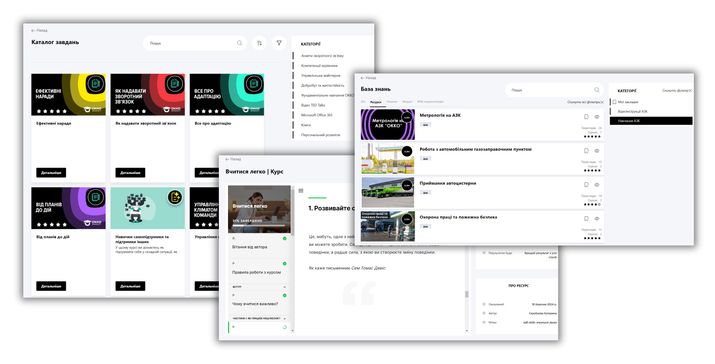
According to Precedence Research, the global corporate e-learning market is estimated at $10.20 billion in 2025 and is expected to grow to $14.63 billion by 2034 (CAGR 4.09%). At the same time, the LMS market is showing an even faster pace: from $12.02 billion in 2024 to a projected $72.30 billion by 2034 (CAGR 19.65%).
These figures are not just statistics – they indicate a rapid growth in investments in digital learning. In Ukraine, this trend is also noticeable: large businesses are automating employee development, looking for more flexible approaches and investing in internal universities. As the market is changing rapidly. Companies are forced to quickly respond to new requirements, retrain teams and adapt newcomers. At the same time, there is a fierce competition for talent, and training is becoming a key factor in employee retention and development.
That’s why more and more businesses are moving away from traditional training – it simply can’t keep up. Let’s take a look at why.
What’s wrong with traditional training?
❌Disengagement from the work process
Employees are forced to put aside their daily tasks to listen to a lecture or attend a training session. In addition, the knowledge gained often remains a theory that is difficult to apply in practice.
❌High cost and logistical complexity
Conducting offline training requires significant costs: for trainers, rental of premises, business trips and logistics. For companies with distributed teams, this also means additional coordination and planning tasks.
❌Difficulty of scaling
Traditional training methods are difficult to scale as the team grows. The “one size fits all” approach is not suitable for people with different experience and positions. Because of this, training can be perceived as a formality, rather than a real development tool.
❌Lack of measurable results
The biggest problem with traditional training is the lack of transparent analytics. What knowledge did employees gain? Did they apply it? Has their effectiveness changed? Without analytics, these questions remain unanswered.
How is learning transforming in successful companies
Companies are looking for new ways of learning that work quickly, flexibly, and produce results.
Here’s what Ukrainian and foreign companies are already doing:
Combine online and offline learning
Training is built as a combination of online courses and offline activities. Employees learn theory at a convenient time through learning platforms, and practice practical skills in workshops or directly at the workplace.
This approach provides flexibility. For example, a new product can be told through a video, leadership skills can be practiced in a workshop, and knowledge can be tested with tests and in real work.
Create individual programs
Modern companies are abandoning universal programs for everyone. Instead, they are creating individual learning routes for employees, taking into account their position, experience, and goals.
This motivates people to learn, because they get the knowledge they need. A new sales manager learns customer service techniques, and a team leader develops leadership skills and strategic thinking.
Focus on practice
Training is as close as possible to real work tasks. Less theory – more practical exercises that are similar to what employees solve every day.
These can be simulations of real situations, analysis of specific cases or practical tasks. This approach helps employees immediately apply new knowledge in their work.
Measure results
Training systems collect data on how employees complete courses, what grades they receive, how their skills develop. HR teams and managers see the full picture of how training affects work.
This helps build training strategies based on real facts, not guesswork.
What can you do now?
Start with a goal analysis
Before implementing a new training system, it is important to clearly define what exactly needs to change after training. What specific employee skills do you need to develop? What business indicators do you need to improve? What problems does the training need to solve?
Choose a platform for scaling
Choose an LMS that allows you not only to conduct training, but also to scale with the company. The system should be flexible and adaptable to your needs.
Create basic learning trajectories
Start with the most necessary programs: adaptation of new employees, development of managers, sales training, etc. This will help to form a learning culture. Over time, you can expand the content and coverage.
Regularly measure the impact
Create a system of metrics that will show the path from knowledge to business results. Regularly analyze this data and adjust training programs.
Conclusion
The difference is not in the format – the difference is in the philosophy. Successful companies understand that training today is not an expense, but the most profitable investment. Every hryvnia invested in team development returns in rapid adaptation to changes, higher productivity and loyalty of talents.
Yes, unfortunately, exclusively traditional approaches no longer meet the pace of modern business. Outdated formats are difficult to scale, difficult to measure and even more difficult to adapt to the reality
challenges. Instead, flexible, digital, and practical solutions give companies the edge. They allow learning to happen in the flow of work and accurately measure learning effectiveness.
The future of corporate learning has already begun. And it belongs to those who act today.