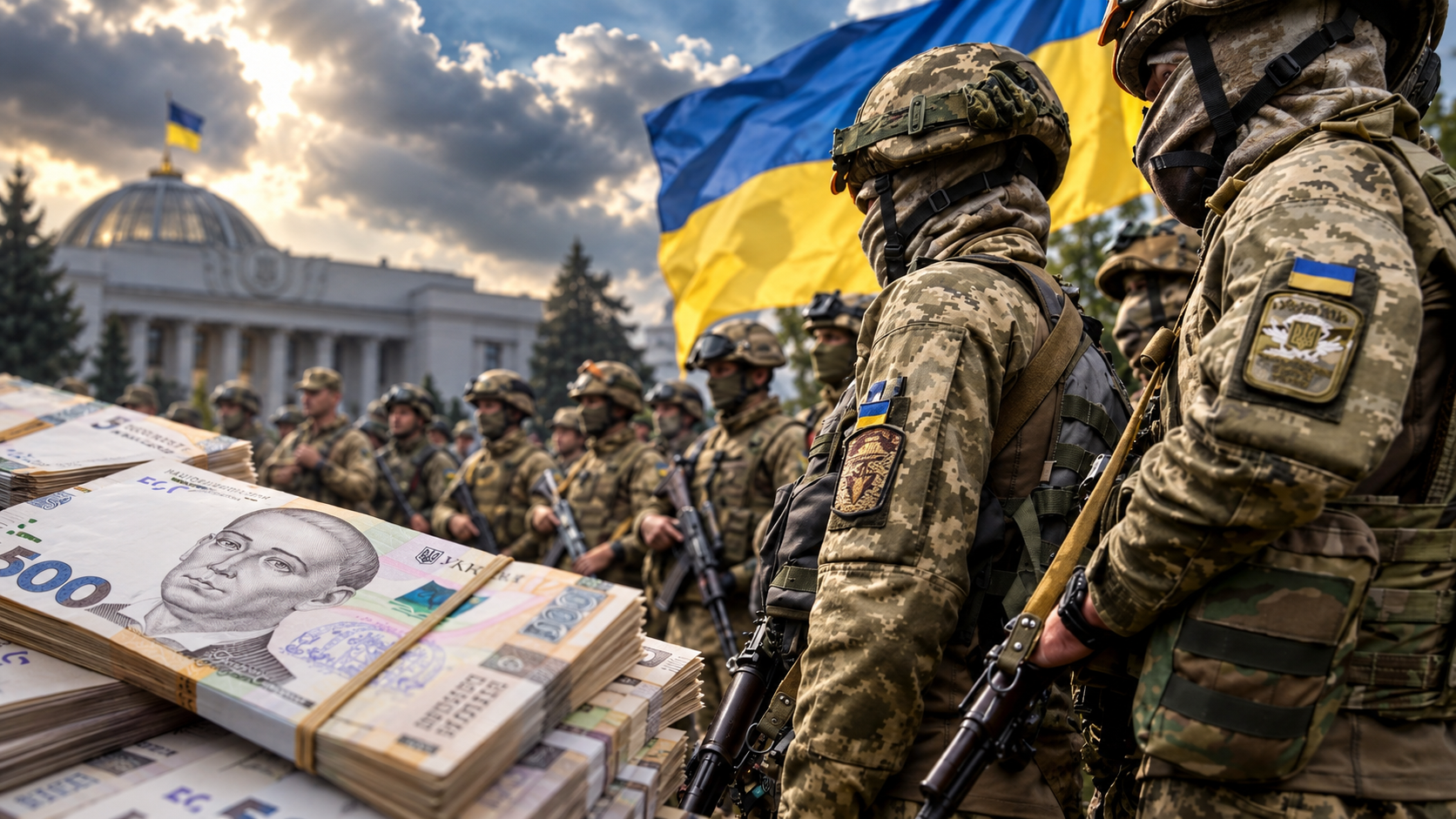
Ukrainian authorities do not plan to announce new incentive contracts for military personnel featuring large additional financial packages in the near future, as state budget resources remain extremely limited. At the same time, the system of incentive contracts and increased combat pay—launched in the summer of 2026—remains in effect; the issue is not about cancelling it, but rather avoiding new promises that lack guaranteed financial backing.
This statement was made by Fedir Venislavskyi, a member of the Verkhovna Rada Committee on National Security, Defense, and Intelligence. He emphasized that certain Ministry of Defense officials had previously made financial promises that, according to him, were not fully supported by the budget’s actual capabilities. Venislavskyi described this practice as negative, noting that it creates expectations among service members that the state may subsequently lack the resources to fulfill. However, he stressed that the principle of incentivizing contract service is not being abandoned; the parliamentary committee will continue to promote mechanisms designed to make voluntary recruitment into the Defense Forces more attractive.
It is important to distinguish between two things here. Incentive contracts already exist in Ukraine and remain in force. In June 2026, the Cabinet of Ministers launched a new contract service system via Resolution No. 768, featuring clear terms, increased combat bonuses, and a deferral period following contract completion. Therefore, Venislavskyi’s current statement does not signal a rollback of the reform already underway.
Currently, three main types of new contracts are in use within the Defense Forces: infantry-assault, combat, and basic. A 14-month contract is available for civilians enlisting as infantry or assault troops, while a shorter term applies to specific categories of active-duty personnel. Contracts for other combat and non-combat specialties generally run for 24 months.
The highest payments are reserved for troops performing the riskiest missions. According to official Defense Forces data, the average estimated income under an infantry-assault contract can reach around 300,000 hryvnias per month, with a maximum of up to 460,000 hryvnias for those directly involved in the most dangerous combat operations. For UAV operators, artillery crews, electronic warfare (EW) specialists, and other combat roles, monthly payments range from 30,000 to 120,000 hryvnias, depending on service conditions.
There are also separate bonuses for specific combat achievements, additional payments for frontline service, and annual social allowances.
For instance, under the current system, a soldier might receive 10,000 hryvnias for each day spent directly at a combat position, 20,000 for specific tasks involving the restoration of positions, and 40,000 for assault operations. It is precisely these supplements that allow the total payout to significantly exceed the base salary. Thus, the issue Venislavskyi is highlighting is not that the state refuses to pay according to the established system, but rather that any further sharp increase in financial incentives would require massive additional resources—an area where the state is indeed facing increasingly serious difficulties. The war is already costing Ukraine $190 million a day
Roksolana Pidlasa, Chair of the Parliamentary Budget Committee, recently announced that a single day of war in 2026 costs the Ukrainian budget approximately $190 million. For comparison, in 2024, this figure stood at around $140 million per day. According to her, in the first eight months of 2026 alone, the state spent about $42 billion on the security and defense sector, excluding in-kind military aid from partners. Meanwhile, domestic budget revenues and internal borrowing during this period amounted to approximately $39 billion. In other words, even domestic resources are no longer sufficient to fully cover current defense needs. This explains why any new large-scale increase in salaries or one-off bonuses for hundreds of thousands of service members must be calculated not in millions, but in tens and hundreds of billions of hryvnias.
The 2027 budget allocates nearly UAH 4.9 trillion for defense
In the draft state budget for 2027, the government proposes allocating UAH 4.885 trillion to security and defense—representing 43.8% of the country’s projected GDP. Of this amount, nearly UAH 1.792 trillion is earmarked for personnel costs and related charges, while another UAH 2.299 trillion is designated for weapons and military equipment.
For comparison, total state budget revenues for the coming year are projected at UAH 5.648 trillion, while total expenditures are set at UAH 7.272 trillion. The state will also require approximately $52.6 billion in international financial support. Consequently, even with a record defense budget, there is little room for new, large-scale financial pledges.
Why partner funds cannot simply be used for salaries
There is another issue: a significant portion of international aid is earmarked for specific purposes. For instance, Nenka.info previously reported that a substantial part of the EU’s large €90 billion loan package cannot simply be allocated to raising military salaries.
European funding is largely focused on arms procurement, the defense industry, and other specific areas. The EU is providing Ukraine with €90 billion, but not for military salaries; Brussels has explained where to find the funds for payment increases. This means that the financial remuneration of service members remains, to a significant extent, a burden on the Ukrainian budget itself.
What has already changed in 2026
The current contract reform was launched in June. At the time, Nenka.info reported on Cabinet of Ministers Resolution No. 768, which introduced new types of contracts featuring fixed service terms, differentiated pay, and a guaranteed deferral from service after discharge.
New contracts in the Armed Forces: the government has drastically changed service and payment rules
The publication also reported that military personnel who do not switch to the new contract model continue to serve under existing mobilization rules until legal grounds for discharge or demobilization arise. New contracts in the Armed Forces: those who do not sign will serve until demobilization. Separately, the Ministry of Defense emphasized that some of the new combat-related payments do not depend on signing the “motivational contract” at all. They apply to both mobilized troops and those serving under older contracts. This reaffirms that the current discussion does not concern the cancellation of previously established payments.
What might happen next
Venislavskyi states explicitly that the motivational component of contract service will remain one of the primary tools for recruiting people into the army. However, according to him, lawmakers want to avoid a scenario where an extremely attractive sum is announced initially, only for it to emerge later that the budget cannot consistently sustain it. Therefore, the primary focus in the near future will likely remain on the model already in place: a defined term of service, higher pay for risk and direct combat involvement, additional bonuses, and a guaranteed deferral period following the contract. As of September 20, there have been no public decisions to scrap or scale back the current contract system. However, the introduction of new, large-scale financial incentives—such as even larger one-off bonuses or a sharp increase in base pay for all categories of military personnel—will now depend directly on whether the state can secure a stable funding source for them. And this is precisely where Venislavskyi’s position is quite clear: the authorities do not want to make bold new promises without the necessary funds in the budget.