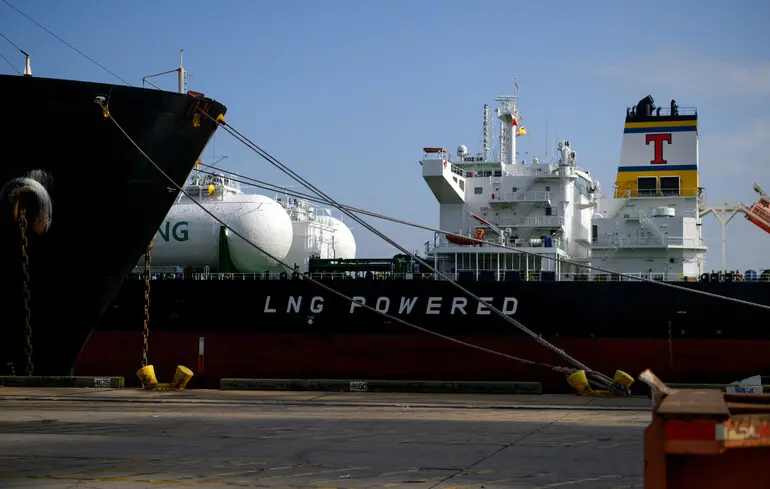
While the conflict in the Strait of Hormuz blocks a fifth of the world’s oil and gas supplies, the real threat to the LNG industry has come from the rapid decline in renewable energy prices.
Today’s market realities have LNG (liquefied natural gas) producers seriously worried about their future, as a price of $70 per megawatt-hour has become a critical competitive limit. Even without taking into account the geopolitical turmoil in the Strait of Hormuz, the cost of generating electricity from gas is starting to lose ground to renewable alternatives, according to Bloomberg.
The economics of “survival”
The market math currently looks inexorable: if you take the market price of LNG (currently around $50 per MWh in Asia), double it and add about $4 for operating costs, you get the approximate cost of electricity from an existing gas generator. If the total exceeds $70, gas will start to be pushed out of the grid by renewables. The shock will hit Asia hardest, a region that Shell Plc has seen as key to gas demand in the coming decades. Countries like India, Pakistan, Vietnam and the Philippines are facing depletion of their own reserves, but they also have vast solar potential and access to cheap technology supply chains from China.
The climate paradox
An interesting nuance is that almost 98% of new capacity coming online from 2022 is renewable. But the headlines about falling solar and wind prices have not yet translated into significant reductions in CO2 emissions. The reason is simple:
Most of the emissions come from older facilities built years ago.
A fully depreciated gas-fired power plant will continue to operate until the cost of renewable energy falls below its fuel and maintenance costs.
The tipping point is the $70 mark, where hybrid systems—solar/wind plus batteries—become more reliable than gas.
The Triumph of Hybrid Technologies
In China, India, and Texas, a solar farm with a four-hour battery can already reliably power data centers at a cost of $75–79 per MWh. The International Renewable Energy Agency (IRENA) notes that in sunny regions, such systems guarantee power 95% of the time at a cost of $54 to $82 per MWh.
Moreover, contracts are already appearing on the market that are shockingly cheap:
India’s Morena Project: Promises reliable power for $29 per MWh, half the price of the cheapest gas.
Indian state-owned company auctions: Prices in the range of $52-66 per MWh for solar with storage.
The hazy future of blue fuel
When building a new “clean” plant becomes cheaper than simply operating an existing gas plant, the latter’s role is reduced to a backup function. Forecasts of a future LNG surplus that could lower prices are now having to be revised due to damage to export capacity in Qatar due to fighting.
At the same time, IRENA predicts that the cost of “renewable energy + storage” systems will fall by another 30% by 2030. Under such conditions, even the cheapest gas in the world is unlikely to be able to compete, and LNG’s role as a “reliable fuel” in Asia is perceived as a bad joke against the background of regular power outages due to the inability to obtain fuel supplies.
The Iranian crisis has doubled gas prices and left Europe with record-low gas storage facilities. But while the EU is using the shock as an incentive for a systemic restructuring of the energy sector, Ukraine continues to patch up holes and risks entering next winter with minimal reserves. Ukraine Facility Platform analyst Maria Tsaturyan explains in her article “The Gas Crisis in Europe. Will the EU and, especially, Ukraine, overcome it” how Ukraine can stop being a recipient of aid where it could become a partner.