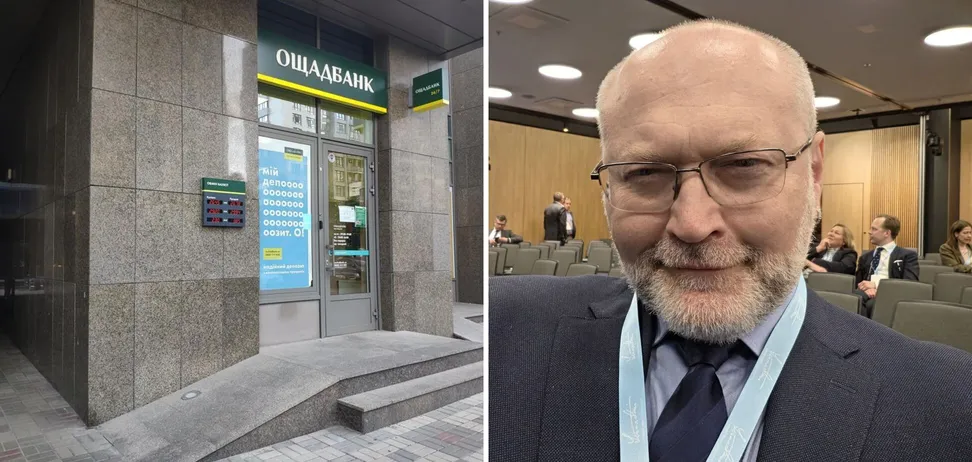
The Commercial Court of Vienna (Austria) has made a preliminary ruling in favor of Oschadbank in a case on the protection of business reputation related to the so-called “Hungarian case”. This concerns the statements of former MP Boryslav Bereza regarding the bank’s transportation of cash and valuables through the territory of Hungary. As reported by the bank’s press service, the court granted the application for a precautionary measure filed at the place of permanent residence of the defendant, i.e. Bereza, in Austria. According to the ruling, Bereza must:
refrain from further spreading accusations against the bank and its officials;
delete previous publications, in particular on social networks.
For violation of the ruling, the defendant may face a fine of up to 100 thousand euros for each instance of violation. In such a case, the funds are paid to the Austrian budget. Oschadbank explained that the preliminary injunction is provided for by Austrian law as a mechanism for the prompt protection of reputation and prevention of further dissemination of false information. The next step will be to file a main lawsuit for the protection of business reputation in an Austrian court. The bank plans to seek a final injunction against the dissemination of false information and compensation for legal costs. The bank also notified the Facebook and Telegram administrations of the court’s decision in accordance with the requirements of the European Union and the Digital Services Act to ensure the forced removal of the disputed publications if the defendant does not do so himself.
What Bereza said about the “Hungarian case”
Boryslav Bereza publicly stated that Oschadbank could allegedly operate a scheme for the “shadow” withdrawal of currency and gold abroad through its collection cars. He claimed that the armored cars traveled along a route through Austria and Serbia, and that cash could allegedly be exchanged on the territory of Ukraine. Bereza also claimed that officials from the Office of the President and the National Bank of Ukraine were allegedly involved in this logistics. He separately drew attention to the fact that Oschadbank, according to him, “used a different cash delivery scheme than other large banks.” As of the morning of May 21, these posts on his Facebook have already been deleted.
The bank called these statements false and damaging to its business reputation. Oschadbank noted that the transportation of funds and valuables was carried out within the framework of an international agreement with Raiffeisen Bank International. According to the bank:
the cargo was registered in accordance with international customs rules and transport procedures;
the packaging of money and gold met regulatory requirements;
Oschadbank has a valid license for international transportation from the State Service of Ukraine for Transport Safety;
during the war, such transportation is carried out exclusively by land transport;
the funds were transported from Vienna to Ukraine in transit through Hungary to ensure cash circulation in the country.
The bank also emphasized that the legality of the transportation is confirmed by the fact that the Hungarian side returned the bank employees, the collection cars, as well as the funds and valuables without any charges.
What preceded
On March 5, two collection cars of the Ukrainian Oschadbank were detained in Hungary along with seven employees, transporting 40 million dollars, 35 million euros and 9 kilograms of gold from the Austrian Raiffeisen Bank International to Ukraine. Volodymyr Zelenskyy then called it an open robbery. But the very next day, the collectors were released, and on March 12, the cars were also handed over. However, Hungary returned the cash and gold only 2 months later.
The Hungarian tax and customs police opened criminal proceedings against the Ukrainian collectors of Oschadbank on suspicion of money laundering. At the same time, they were banned from entering the Schengen area.
The leader of the Hungarian Tisza party, Peter Magyar, after his party’s victory in the parliamentary elections, announced his intention to initiate an investigation into the materials on the basis of which the government of his predecessor Viktor Orban confiscated the funds of the Savings Bank. “We don’t know the reality, we only saw propaganda news,” he said.